
Lire l’article en Français sur notre site
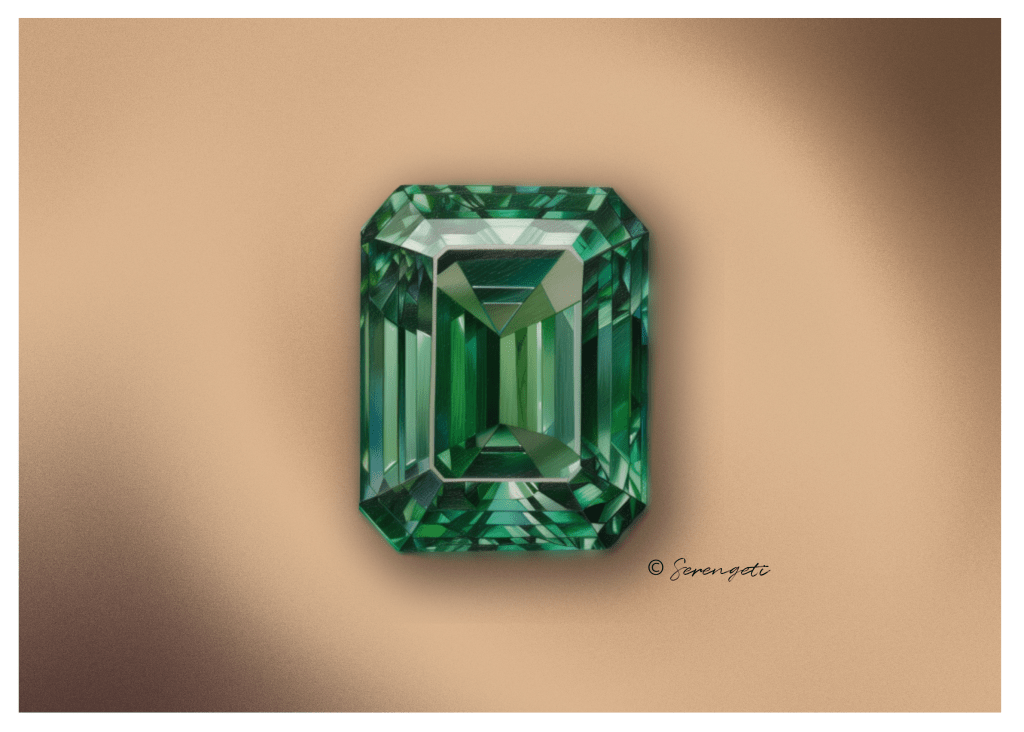
Emerald is the « green stone, » a gem attributed with extraordinary powers that has fascinated humans since ancient times.
History
2,000 years before Christ, it was already used as currency in the markets of Babylon. The first known mines are those of Upper Egypt, where emeralds adorned the jewellery of Queen Cleopatra.
The emerald is highly present in myths and legends: It’s the stone that fell from Lucifer’s forehead when he was cast out of heaven and the one in which the Holy Grail was carved.
Its name comes from the Greek « smaragdos » (« green stone »), and it referred to various gems of the same color.
Furthermore, it was considered a powerful talisman capable of restoring sight and protecting against snakebites.
Colour
The color of emerald is associated with a dense, saturated green, fern, or bottle green, giving its name to a shade of green: emerald green !
However, the colors it presents are far from uniform. Many shades exist, especially among emeralds from different countries. Brazilian gems reveal yellow-green reflections, while Colombian emeralds have blue nuances, but as often is gemmology things are not as easy as they seem, one must not rely on colour to identify an origin.
Emerald is the green variety of beryl, closely related to aquamarine. It is composed of aluminum and beryllium, and its color is due to the presence of chrome or vanadium in small quantities.
Emerald has an acceptable hardness of 7.5 – 8 (compared to 10 for diamond, 9 for ruby and sapphire), but its numerous inclusions make it a stone that can be fragile.
Origin
The most famous emerald deposits are those of Colombia, discovered during the country’s conquest by the Spanish. The mines of Muzo (1560), Coscuez (1646), and Chivor (1904) are known worldwide.
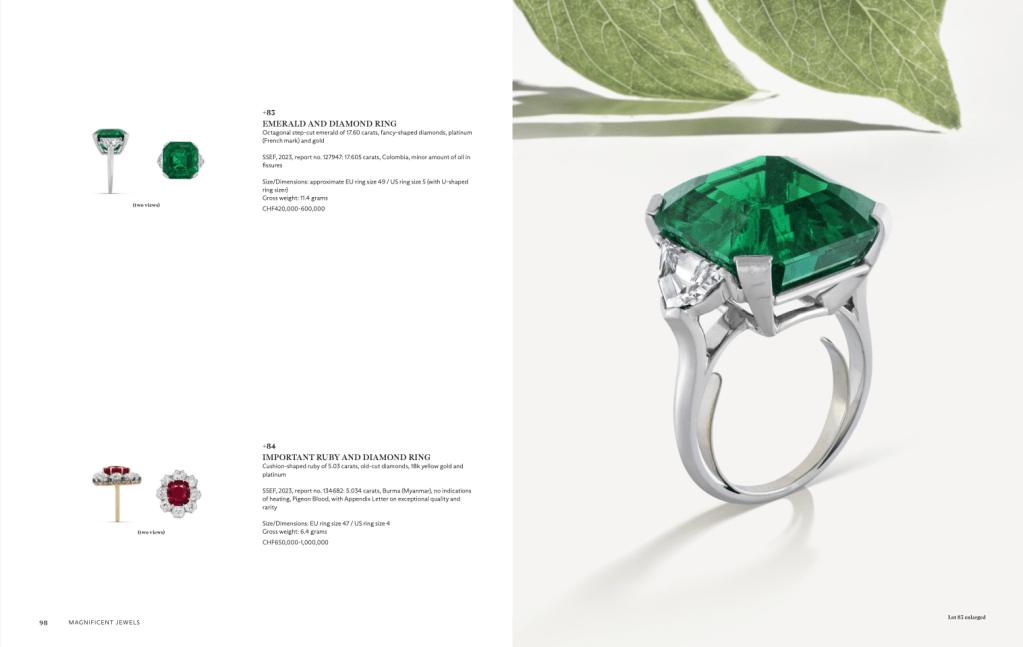
Until now, it was believed that the mines in Egypt, exploited by the Pharaohs (from 3000 to 1500 BC), and those in Habachtal (Austria), discovered by the Celts, were, in the old World, the only sources of emeralds until 1545.
But recent research conducted by the Development Research Institute has shown that other mines were exploited in antiquity. The research focused notably on an emerald adorning a Gallo-Roman earring. This emerald originated from mines located in the Swat Valley (Pakistan), which were believed to have been discovered only in the late 1950s.
It appears that alongside the gems from Egypt or Habachtal, some emeralds traded during antiquity could have come from the wealthy kingdoms occupying present-day Pakistan and Afghanistan, partially traveling the Silk Road through the valleys of Peshawar, Swat, and Kabul.
In 1830, significant deposits were discovered in Russia in the Urals.
Since then, other countries have become producers: Brazil, the largest producer in terms of quantity, followed by the African continent, with Nigeria, Zambia, Zimbabwe, Madagascar, and recently Ethiopia.
Some of the Emeralds Serengeti holds come from the region of Manyara in Tanzania.
Asia remains present with the fabulous stones of the Panjshir Valley in Afghanistan, rediscovered in 1976. Pakistan and Australia are also significant producers.
The most beautiful emeralds, worked or cut, can be found in the Crown Treasury in Tehran (Iran) and at the Topkapi Museum in Istanbul.
The most famous crystals are those of the Bank of the Republic in Bogota (Colombia).
Cut
Just as there’s « emerald green, » emeralds have their cut, known as the « emerald cut. » For emeralds, cutters have aimed to showcase the color rather than the brilliance, as with diamonds or other gems.
It’s believed that this rectangular cut with its beveled corners, also known as a step cut in the jargon, particularly reveals the beauty of this stone.
Lower-quality emeralds are often cut into cabochons or simply into spherical shapes.
Alternatives
Green grossular garnet (Tsavorite) and some green tourmalines are among the gems whose color is closest to that of emerald.
There’s also a very high-quality jade whose color rivals that of emerald, but its price reaches staggering heights (Imperial Jade).
Imitations and Synthetics
Several processes allow for the synthesis of emerald. They are grown in laboratories using aqueous solutions or by fusion.
It’s difficult to distinguish a real emerald from a fake with the naked eye. They have the same composition and characteristics. A trained eye and a 10X magnification loupe usually suffice to distinguish them.
The main imitations of emerald are glass and composite stones (called « doublets »), consisting of two parts of colorless beryl cemented together by a green adhesive.
Easy to identify when the stone is « loose » on paper in the jargon (referring to the paper folds in which traders transport stones), the effect can be quite convincing once the stone is set in jewelry.
Treatments
90% of the emeralds found on the market are oiled with a colorless oil. This process enhances their appearance by concealing fissures, making them less visible. This beautification technique is considered by global gemology organizations as a natural and legal operation.
However, filling the fissures of the emerald with colored oils or resins must be disclosed upon resale with the mention « treated emerald. » These treatments are often irreversible and significantly impact the price of gems depending on the technique used.
Price
As with many gemstones, the per-carat price of higher-quality emeralds increases exponentially. For example, a superior-quality Colombian stone of 3 carats will be many times more expensive than three stones of equivalent quality of 1 carat each.
The factors determining value largely depend on color, with nuances of saturation and hue affecting the price to a large extent. The most desirable color is a slightly bluish green in a moderately dark tone with strong to vivid saturation.
Care
Emeralds are sensitive to shocks and abrasion. The numerous inclusions they carry can make them fragile.
When set in a ring, emeralds should be protected; it’s prudent to choose a setting that guards the stone, such as a bezel setting instead of a prong setting.
And it is essential, if you want to enjoy your jewellery for many years, not to wear it for gardening, sports, or any other physical activity.
Mechanical cleaning is not recommended for emeralds. Ultrasonic cleaners and steam can cause emeralds to fracture. Use only warm water, mild soap, and a very soft brush for cleaning, or take your emeralds to a professional jeweller.
Lire l’article en Français sur notre site
 SERENGETI GEMS ©
Laisser un commentaire